
The world's biggest lockdown that shut a majority of the factories and businesses, suspended flights, stopped trains and restricted movement of vehicles and people, may have cost the Indian economy Rs 7-8 lakh crore during the 21-day period, analysts and industry bodies said.

The government has limited room to reduce expenditure without further weakening growth, it noted.

The National Council of Applied Economic Research, which had forecast the country's economy to grow by 8.5 per cent in 2007-08, has raised projection to 8.9 per cent on improved performance of agriculture and services sectors.In case of industry, although the investment climate continues to be strong, the slower growth of exports may be a dampening factor, but retained the growth in industrial sector unchanged at 9%.

BofA-ML revised its end-2015 rupee-dollar forecast to 60 from 64 earlier.

Observing that India's worsening COVID-19 situation and the strict measures to contain it have hit the economy hard, the rating agency said productive capacity has been severely disrupted since the start of the pandemic.

With this subdued forecast, India is likely to record its worst growth performance since the 1991 liberalisation. However, it is among the only two major economies, which will register a positive growth rate in 2020. The other being China, for which the IMF has projected a growth rate of 1.2 per cent.

India's economy will do well once vaccination reaches a critical mass as pent up demand, global recovery and easy financial conditions will boost activities, RBI's Monetary Policy Committee (MPC) member Ashima Goyal said on Tuesday.

The Economic Survey seems convinced that 2019-2020 saw the bottom of the economic cycle, points out Abheek Barua, chief economist, HDFC Bank.

India's economic growth is now 'extremely fragile' and needs all the support that it can get, as private consumption and capital investment are yet to pick up, RBI Monetary Policy Committee (MPC) member Jayanth R Varma said on Friday. Varma further said out of the four engines of growth for the economy, exports and government spending supported the Indian economy through the pandemic, but other engines need to pick up the baton now. " I like to think in terms of the four engines of growth for the economy: exports, government spending, capital investment and private consumption. "...while exports cannot be the main driver of growth because of the global slowdown, government spending is necessarily limited by fiscal constraints," he told PTI.
While efforts are being mounted on a war footing to arrest its spread, COVID-19 will impact economic activity in India directly through domestic lockdown. The second-round effects, it said, would operate through a severe slowdown in global trade and growth.
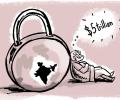
India's growth and success is guaranteed, he said propagating his idea of making the country self-reliant by cutting imports.

Reliance was the top gainer in the Sensex pack, surging over 3 per cent, followed by ICICI Bank, Bharti Airtel, Dr Reddy, Maruti and ITC.

Policies to address CAD has worked well believes the bank's economists.
The finance ministry will have to rely on the weapons in its arsenal, since monetary policy is not providing the support.
RBI said aggregate demand during the year so far suggests that the shock to consumption is severe, and it will take quite some time to mend and regain the pre-COVID-19 momentum.
The International Monetary Fund (IMF) has cut down its 2013 forecast for global economic growth to 3.9 per cent from the 4.1 per cent, trimming projections for most advanced and emerging economies.

Shifting its stance of monetary policy towards targeting retail inflation as it is an "inequitable tax", RBI today said it may exceed 8 per cent by March end and efforts will continue to bring it down.

The investment banking major has hiked its FY'14 CAD forecast to 4.3 per cent of GDP from 3.8 per cent with slowing global recovery likely to delay export turnaround.

Equity benchmarks extended their decline for the fourth straight session on Wednesday, with the Sensex falling 214.85 points after the Reserve Bank raised the key interest rate by 50 basis points. Continuous foreign fund outflows and surging crude oil prices also weighed on markets. The 30-share BSE benchmark dropped 214.85 points or 0.39 per cent to settle at 54,892.49.
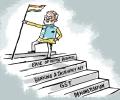
Three-quarters into the 10 years that Mr Modi had sought for transforming India, the 'output' numbers look impressive, but the key 'outcome' numbers don't show up much, if at all, observes T N Ninan.

The Indian economy is likely to benefit from tailwinds from both monetary and fiscal policy in the coming month

The WPI has been in the negative zone since November.

A report published in British journal The Lancet reckons India's working population will surpass China's in the mid-2020s.
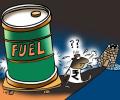
India must be prepared for a big, fat fuel import bill in FY23 - barring any further avatars of the Covid virus - as refiners crank up runs, or crude processing rates, to meet the growing demand for fuels, and crude prices soar. Capacity additions by an Indian state-run refiner will reinforce the need for foreign crude. Demand for all fuels is expected to increase by 3-8 per cent next fiscal from 2021-22, reaching pre-pandemic levels, according to analysts and industry experts.

RBI expects the growth in the next fiscal to strengthen gradually, notwithstanding the significant headwinds.
Fiscal deficit, the gap between government's expenditure and revenue, stood at 4.5 per cent in FY14, lower than 4.9 per cent in FY13.

The survey, however, said that GDP is expected to revert to growth terrain next year, when it is likely to grow by 7.2 per cent.

The repo rate has been left unchanged at 4 per cent, Governor Shaktikanta Das said while announcing the decisions taken by the central bank's MPC.
Even in the coming fiscal, the growth is likely to be in the range of 7 to 7.5 per cent, the PM's panel said, adding that inflation will moderate to four per cent by February-end. The gross domestic product growth was 9 per cent in 2007-08 and inflation has already declined to below six per cent in January from the peak of 12.91 per cent in August 2008.
Let's take a look at how India and world's major economies will perform in the next four years.
Unctad's GDP projection is broadly in line with forecasts by Indian agencies like the Reserve Bank of India and the Prime Minister's Economic Advisory Council, which have projected a growth rate of 7.9 per cent and 7.7 per cent respectively in 2008-09, as against 9 per cent recorded in 2007-08. Finance Minister P Chidambaram expects the Indian economy to expand by more than 8 per cent this year.

Moody's said it expects exposure to low oil prices to shave off 0.8 per cent from real GDP growth on average across oil exporting countries in 2016.

The Reserve Bank on Tuesday said growth is expected to fall below 5 per cent in 2013-14 in absence of pick-up in manufacturing sector, but likely to recover to 5.5 per cent in the next financial year.

'India is in a slowdown which most of us have not seen in our living memory.'

Nepal's decision to ban the import of non-essential items amid depleting forex reserves may hit Indian exports. The country's central bank - Nepal Rastra Bank - last week instructed commercial banks not to open letters of credit (LCs) for importing non-essential items. This is to prevent further decline of the country's foreign exchange reserves. However, it has not issued any formal communication yet.

Pegging the cost of the covid-19 lockdown at USD 120 billion (approximately Rs 9 lakh crores) or 4 per cent of the GDP, analysts on Wednesday sharply cut their growth estimates and stressed on the need to announce an economic package. The Reserve Bank of India (RBI), which is scheduled to announce its first bi-monthly policy review on April 3, is set to deliver a deep rate cuts and it should also be assumed that the fiscal deficit targets will be breached, analysts said.

Finance Minister Nirmala Sitharaman is likely to strike a fine balance between being fiscally prudent and growth supportive when she presents her fourth straight budget on Tuesday, which is expected to have plans to boost spending to revive investment and create jobs. The Budget for the fiscal year starting April 1, 2022 is likely to raise spending on infrastructure to set the economy on a firmer footing. The stage for the Budget presentation was set by the Economic Survey stating that the government has the fiscal space to do more to support the economy that is forecast to grow at a healthy 8-8.5 per cent growth in the 2022-23 fiscal.
ADB, however, has cut its growth forecast for developing Asia to 6.1 per cent from the earlier 6.3 per cent in view of subdued economic activity in the US and China.

In the Sensex pack, HDFC, ONGC, Bharti Airtel, Titan, Asian Paints, Mahindra and Mahindra and TCS were the prominent gainers. On the other hand, ICICI Bank, IndusInd Bank, NTPC, UltraTech Cement, Tech Mahindra and SBI were among the major laggards. On the other hand, HCL Tech, Tech Mahindra, HUL, Bharti Airtel and ICICI Bank were trading in the red.
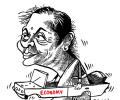
While the situation Sitharaman finds herself in may not be that good, how does it stack up against her three immediate predecessors Pranab Mukherjee, P Chidambaram and the late Arun Jaitley?
